Assisting enterprises in learning, exploring, reengineering, and implementing component-based/object-oriented software solutions using best-in-class methods.
|
| Pick Your Process |
| Stating the Obvious |
Okay, you, your team, company, is about to start a project. You've identified your problem. Well, you think you have. Chances are, your problem is about the "use of technology" and it is not really a business problem. That is, it's more of a the technologists' problem to get into new technologies. But that's not what this discussion is about; I thought I'd just throw that in for good measure. But regardless of whatever you're attempting solve, you probably started somewhere down in the tactical layer. Particularly if it's about applying some new technology. So that brings us to the thrust of this discussion, which is the reason we do anything at all for that company that pays us at appropriate intervals. It better be for the company's bottom-line and not for another line for your resume.
|
| Back to Basics |
|
One of the benefits of being involved in the system development biz a couple of decades is that I've had the benefit |
| Forces |
| Different parts of an organization must analyze activity and opportunities. For example, Marketing wants to see who has not purchased in a period of time and who might be interested while Sales wants to know the demographics of current sales. Information about a single Party can be stored once. Who cares whether Acme Grommets is a Customer, a Vendor, or a Competitor? Why keep redundant information in three separate databases? Worse yet, not even knowing they are the same entity! |
| Solution |
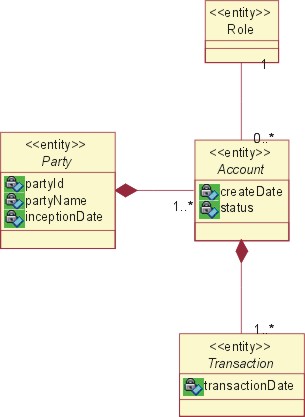
| Do not keep a Customer or Member concept. Make Customer and Member an instance of a 'Role'. Make role an attribute of an Account. The Account object keeps a reference to the Party. In this way, the Party can have several Accounts, each with a different (or even the same) role. |
 |
|
The above is an extreme simplification. However, the fundamental concept is the Account. The Account is the primary tool for managing business. It is the instrument that accrues historical information. It is the Account's state (status) that a business cares about. For example, one part of the business may define ANY party with an Account where the Role of the Account is Customer. Another part of the same business may define a Customer as any Party with an Account where the Role is Customer and the status is Active. Use Fowler's Accountability Pattern to provide further refinements, e.g. restricting what a Role can do - Purchase. Also, Locations may be associated with the Account rather than the Party. For example, one Account's Billing Address may be X while another Account's Billing Address is Y. |
| Related Patterns and Known Uses |
| As stated above, see Fowler's Accountability Pattern. This pattern has been used widely in the author's practice for several clients. |
Copyright©2000 Marcus Software Designs, Inc.